Tag Archives: Writing

Just in time for Spring: Tasso by Papas

Tasso 1

The spring read for today is a book first printed in 1966: Tasso by William Papas. Tasso is a heart-warming, timeless fable of tradition versus change and this stunning new edition will be published by Pikku on 9th April 2017. Papas received numerous nominations for the CILIP Carnegie and Kate Greenaway Medals throughout his career – including for his lifetime’s work. He was also a renowned political cartoonist as well as a children’s book illustrator.  His work is held in collections around the world, as well as at the V&A Museum in London.

Tasso by William Papas

The Trocadero café is the lively centre of a Greek fishing village, thanks to Tasso and his bouzouki. But one day the proprietor installs a juke box, and Tasso is no longer needed. At first everyone is happy with the uninterrupted music, but gradually the noise becomes unbearable and the Chief of Police must take control.  Will Tasso and his bouzouki be welcomed back to the café once more?

In this zesty and humorous depiction of Greek Island life, Papas’ timeless take continues to speak to us about the values of tradition, simplicity and shared experience.

Tasso and his sister Athena work in The Trocadero to help their father, a fisherman, support the family.  It is hard work but they enjoy it.  However Tasso sometimes get tired and has to rest, so the restaurant owner decides to solve the problem by getting a jukebox which will play all day and all night.  Tasso is no longer needed. But the change of music changes everything else too, and The Trocadero is not what it once was.  Athena, the villagers and even the Chief of Police are all affected and the proprietor must decide how he can restore The Trocadero, and indeed the village, to its usual happy self.

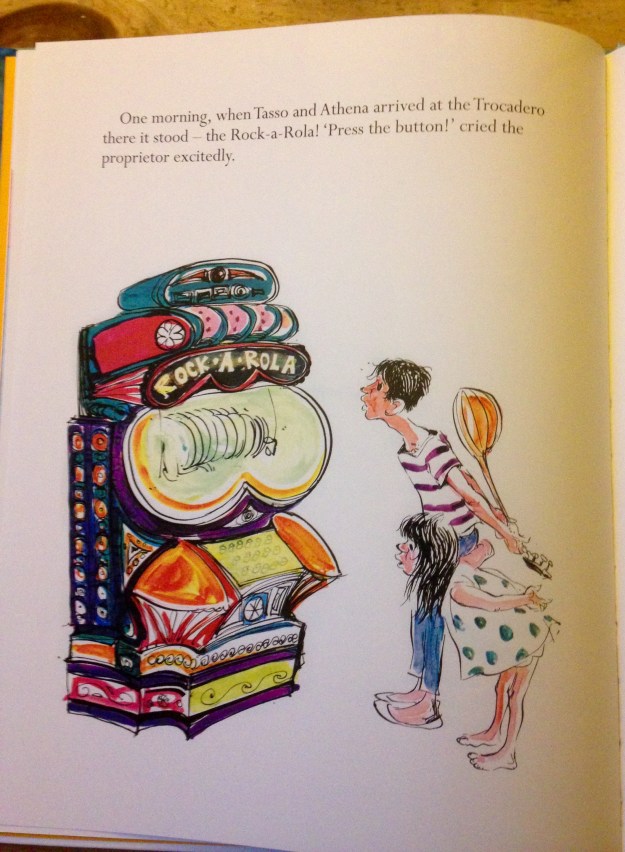
My first instinct when I read this book was that I love it – it’s totally unique and the story is timeless. I travelled to the Greek islands when I was younger and fell in love with them, so perhaps this helps! Tasso is full of character and what strikes you instantly is the vibrancy of the illustrations, immediately bringing to life the Greek village; you can virtually smell the sea air and hear the voices of the eye-catching villagers.  Each drawing is a piece of artwork in itself and it is no surprise the story leaps off the page.

Tasso 3

Tasso 2

It’s a lovely tale and so indicative of the inevitable change that we all sometimes face; it might be 40 years old but its totally applicable to our lives today.  In this case, the modernisation of the cafe’s music has the opposite effect planned by the proprietor – instead of making people spend more time at the café, it eventually alienates them.
tasso 1

Lovely Tasso and his sister Athena, who are from a hard-working Greek family, immediately feel the effects of this more than anyone else.  And not only this, it causes problems across the whole village – even affecting the donkeys and goats! Very soon the villagers all come to realise the beauty of traditional ways of life.  I’m sure this is something we can all relate to in today’s world of constant change and this story would make a great addition to any school library or classroom book corner.  I also love that it is Tasso, with his bouzouki and beautiful traditional music, that ultimately brings the village back to life again! Tasso shows that even good intentions can have unwanted side effects and that sometimes it’s the simple things in life that are best – something I wholeheartedly agree with!

Find out more at www.pikkupublishing.com.

With thanks to Catherine Ward and Pikku for sending me this book and background information.

flowers 2


Author Interview: Jenny McLachlan

flowers 2

Stargazing for Beginners is a gorgeous novel by author Jenny McLachlan who spent thirteen years of her life teaching English: a job that combined her passion for the written word with her passion for showing off! It also provided her with the inspiration for her books. I’m delighted to be interviewing Jenny for our spring feature today.

9781408879764

You’ve created a lovely heroine in Stargazing for Beginners! Meg’s fascination with space is utterly endearing and it’s so great to read about someone with such a big dream. Tell us about your inspiration for the book. My inspiration came from quite a throw away comment: I was describing the plot of one of my books to my dad (I imagine it involved a lot of dancing) and he asked if I’d ever thought of writing a book about a girl who wants to be an astrophysicist. To me, this didn’t seem like instant romcom material, but I think that’s why the idea grew in my mind. I love a challenge!

The space and scientific elements of the story were very educational; how did you go about researching this? I spent about two months reading books, watching documentaries and visiting universities and museums, and a very pleasant two months it was too! Although a lot of what I learnt – a huge amount of facts – don’t appear in the book, my research was aimed at discovering how a girl like Meg, who understands the complexities of the universe but hasn’t got a clue about music, fashion and pop culture, would cope with being a teenager.

Meg’s Mum and Grandad are so well-described – you can almost smell the incense and strange meals! Were they inspired by anyone you know? Both Meg’s mum and Grandad have come in for a bit of criticism in reviews because of their unconventional (bad?) approach to raising children, but I’ve got a soft spot for them, possibly because they were inspired by my mum and Grandad. My mum was amazing: she took us on ‘magical mystery tours’, let us build dens that took over entire rooms and would let us bake, make and mess things up as much as we liked. She also had, and still does have ‘big causes’ that she supports. She’s a Samaritan and regularly goes to India to help run a charity that funds an orphanage. She would never have done what Meg’s mum did (although she did forget to pick me up from a few parties!) but she did have a life beyond her children, and I was proud of her for this. My Grandad was a toned down version of Meg’s Grandad. He was an electrician who helped develop lightening conductors and he owned 30 boiler suits. He was always covered with plasters and scars because of the various burns he got from making bonfires. Both Mum and Grandad LOVED bonfires. Sometimes they got out of hand…

The scenes where Meg is looking after her baby sister who is being particularly difficult brought back memories of my own children’s childhood tantrums! Are you speaking from experience or did you have to research this?! You’re quite right – the scenes were all inspired by my own experience of having babies! I don’t think it matters whether you are 15 or 50, having to look after a baby is a testing experience. I thought I’d be great at being a mum – organised and super-efficient – but what I didn’t take into account was that my children might not like me organising them in the way I wanted to. Babies are so strong minded! Like Elsa, my daughters have trashed rooms, slept in dog baskets and rubbed huge amounts of baked beans into their hair, I also took them for many, long walks along Eastbourne seafront to try and get them to sleep.

Annie is such a great character; feisty and funny. Where did the idea for her come from? Annie, to a certain extent, was inspired by several students I taught who delighted in fighting against conformity. As a teacher, this was sometimes frustrating – how many times a day did I say ‘Girls, roll your skirts down’? – but I also admired their determination. When I went to school, I was terrified of doing something wrong, so I’m fascinated by students who don’t care if they get told off. Teaching also gave me an insight into what life is like at secondary school for disabled teenagers. Schools are becoming more inclusive places, but there’s still a long way to go, and many assumptions that need to be challenged, before disabled students have access to the same experience as able-bodied children at school.

There are quite a few awkward and sometimes funny moments for Meg – the science show, the dog chase on the sea front and the scenes with Ed in the classroom spring to mind! Did you ever have moments like this as a young girl? My entire life was awkward between the ages of 11 – 15. Hair, makeup, music, relationships, fashion…I didn’t have a clue. I remember watching Top of the Pops, and trying to work out who it was acceptable to like and hate. I felt awkward just walking down the road! One of the most embarrassing things that happened to me at secondary school was a seagull pooing on my head in my first week. Seagulls produce a ridiculous amount of poo in one go and I basically had to wash my hair in a sink. I’ve never put that into a book…It’s too traumatic. I did actually witness the dog chase scene on Eastbourne seafront. It was very funny.

Meg’s big dream is to be an astronaut – when you were growing up what was your big dream? I wanted to write and illustrate books. I’ve achieved 50% of my dream which is pretty good!

Stargazing for Beginners gently reflects on some of the challenges young people might face today – but this doesn’t detract from the narrative. For me, this demonstrates real skill in terms of writing i.e. not getting side-tracked or bogged down with an ‘issue’ but still making it meaningful. How did you approach this? I think you’ve just described the main challenge I have when I write. I want my books to feel ‘realistic’ and address genuine challenges, but I also want to them to entertain and provide a certain amount of escapism for the reader. I think that Jacqueline Wilson is a writer who managers to do this particularly well. It’s a balancing act: I try not to lose sight of what my readers enjoy about my stories – the humour and the strong narrative – but I also try to avoid focusing so much on the humour that the stories become flippant and lose their meaning.

I heard recently on the news that space flight for ‘ordinary’ folk is soon to become a reality as early as next year! Would you like to go to space?! I’d love to go to space, but as I’ve got children, I don’t think I could. I’ve watched too many documentaries and read too many books about disasters in space!

And finally can you share with us your top three pieces of advice for aspiring authors?

  • Keep writing until you find your voice. I never thought I’d be writing romcoms for teens. I’m glad I never gave up writing when I was trying, and failing, to write my first novel: a historical romance set just before the First World War.
  • Thinking time is just as important as writing time. I probably think about my books for as long as I spend sitting down and writing them.
  • No writing is wasted. My First World War novel is still sitting in the attic. It will probably always sit in the attic, but I’d never have written Flirty Dancing or Stargazing for Beginners without it.

Brilliant advice. Thanks so much for joining us today and we wish you every success with Stargazing for Beginners!

You can read my review of Stargazing for Beginners here. Find out more at  www.jennymclachlan.com Twitter: @JennyMcLachlan1 Facebook: Jenny McLachlan or visit www.bloomsbury.com

spring time quote 2


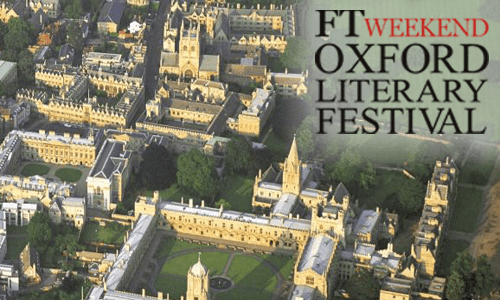
A Super Saturday – at Oxford Literary Festival 2017!

WinnieTheWitchIntroducing Korky Paul at the FT Weekend Oxford Literary Festival, Saturday 25th March.

The day dawned bright and fair. ‘Suited and booted’ wearing my favourite Dorothy-inspired book-ish shoes, I set off to the beautiful city of Oxford for the first day of the FT Weekend Oxford Literary Festival.  I had been asked to introduce none other than Korky Paul, illustrator of the fabulous Winnie the Witch books.  On arriving, it was with great delight I spent an hour or so chatting with Korky and helping a real life Winnie the Witch get ready to entertain the audience!


About 80 or so children and parents arrived, all hugely thrilled to meet Korky – and of course Winnie, who willingly posed for photos with them.  After introducing Korky, I sat back and watched in wonder as he brought to life Winnie, Wilbur and all their wonderful adventures.

With prizes and stories along the way, everyone went away utterly delighted. Korky shared brilliant illustrations tips and was so encouraging of all the children and even read aloud one of the stories.

It really was a special morning. There are few things more inspiring than watching an illustrator at work, perfectly capturing the expression, movement and magic of a character everybody knows and loves!

“Seeing the World Through Children’s Books”  with Elizabeth Laird, Gill Lewis and Anna Bassi, and Nikki Gamble

IMG_3909

This was a great opportunity to hear from two renowned authors and the editor of the fantastic news magazine for children, The Week. Chaired by Nikki Gamble from Just Imagine, the discussion focused on why it is so important to write about the real world for children. Each member of the panel gave a brief talk about their work, starting with Anna Bassi, editor of The Week, a magazine for children which aims to make the news accessible for younger readers.

Anna talked about balancing new stories “with fun stuff so that children could see that the world is not all bad; it’s huge and interesting”.  Having subscribed to The Week both at home and in the school library, I’ve always found it to be an excellent source of news for children and also full of interesting facts, competitions and great stories from around the world.  It is also, most importantly, as Anna described “a safe place to read about serious stories”. I think the whole audience could appreciate the challenge of making news accessible for children in the current climate.

51xdfc5-aUL._SX258_BO1,204,203,200_

Gill Lewis, author of award winning wonderful books such as Sky Hawk and Scarlet Ibis, then shared her inspiration for her new book A Story Like the Wind (out next month), an incredible tale about refugees which Gill described as a “story about the power of stories”. She also spoke about Gorilla Dawn which focuses on the destruction of gorillas and their habitats through the mining of minerals for mobile phone technology.

Gill shared some wonderful insights into her writing, such as taking big events down to one narrative to make the story accessible for young readers.  She talked about finding the character within the story to enable you to create a narrative and enable children to relate to the story.  Gill described her writing as not writing for children, but writing as a child, “exploring what it’s like to feel utterly powerless in an adult world.”

Elizabeth Laird, whose work was characterised as “intrepid” by the panel chair Nikki Gamble and has been translated into 25 different languages, was the final author to share her thoughts.  Her books include the amazing, award winning The Garbage King and The Fastest Boy in the World. Elizabeth talked about her latest novel Welcome to Nowhere, a story about Syrian refugees.  Elizabeth shared an experience of seeing hundreds of refugees arriving at a train station in Munich, making her think of other historical events where multitudes of people have been forced out of their homes.

9781509840472welcome to nowhere_jpg_262_400

This motivated her trip to the Middle East and led her to writing Welcome to Nowhere. Elizabeth made an impassioned plea to the audience to help those “people just like us with perfectly good lives who are now refugees”. Elizabeth’s presentation included images of the refugee camp she visited, home to some 80,000 people.  She also spoke about the children living in absolute poverty on whom some of her other novels are based, and moved many in audience to tears with some of her stories – including me.  Elizabeth encouraged all members of the audience to get involved in raising funds for The Mandala Trust, a charity supporting two schools opened especially for refugee children.  Find out more on her website www.elizabethlaird.co.uk.

The overall thread was the importance of ensuring a message of hope whilst still being true to the story or narrative.  Younger readers should not be patronised but neither should they be made to feel complete despair.  Nikki Gamble asked if there was a line the panel members wouldn’t go beyond with their readers. In response, Elizabeth spoke of having a duty to encourage readers, always showing hope. Gill has had readers who have thanked her for writing stories even about the most difficult of issues, because it helped them get through their own experiences.  And Anna shared that even with the darkest of news stories; there are always opportunities to remember what good people there are in the world, focusing on everyday heroes.

It was a fascinating hour, looking at the power of both fiction and non-fiction to enable children to see the world more clearly.  I think the conversation also showed the ability writers have to help children feel empathy and make informed decisions about the world around them.  This demonstrates why reading is so important, especially in a world which is so visible to children, but also so full of things that are difficult to understand.

Find out more about the Oxford Literary Festival at www.oxfordliteraryfestival.org which runs until 2nd April.

And look out for an interview with Gill Lewis coming up as part of our Spring Feature!


Spring Forward! Special feature coming soon…

Oh the irony of waking up to awful wet weather on the official First Day of Spring! It doesn’t feel much like spring today, so to provide a bit of spring time inspiration, I’m pleased to announce a new special feature coming soon!

Spring time quote

‘Just in time for Spring  will celebrate new authors, new books and general all round inspiration in children’s books. With participation from some wonderful children’s writers and publishers, I’ll be interviewing the people who bring to life new worlds and new characters, finding out all about their new projects. It all starts in the next few weeks, so watch this space!

spring time quote 2


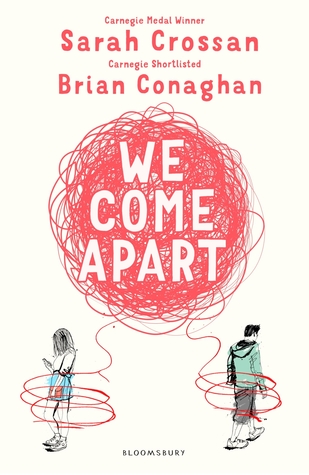
We Come Apart by Sarah Crossan & Brian Conaghan

We Come Apart by Sarah Crossan & Brian Conaghan25310356

Nicu is so not Jess’ type.  He’s all big eyes and ill-fitting clothes, eager as a puppy, even when they’re picking up litter in the park for community service. Appearances matter to Jess. She has a lot to hide.

Nicu shouldn’t even be looking at Jess. His parents are planning his marriage to a girl he’s never met back home in Romania. But he wants to work hard, do better, stay here. As they grow closer, their secrets surface like bruises. And as the world around them grows more hostile, the only safe place Jess and Nicu have is with each other.

Nicu and Jess may be at the same school but couldn’t be further apart when it comes to their backgrounds. Or at least that’s how it seems. Nicu is an immigrant but also a Roma Gypsy and the actions of the school bullies towards him are vile. Equally vile is the treatment of Jess and her mother by Jess’ step-father, a daily trauma Jess is desperate to hide and desperate to escape from.  Jess and Nicu meet properly when they end up on a community service programme.  For Nicu, it’s almost love at first sight when he sees Jess; for Jess, can she really be friends with someone who’s always a target for her mates’ bullying?  Both have secrets they want to hide. As their paths collide, what at first seemed marked differences soon become the threads that hold them together.  Nicu and Jess’ momentary solace in each other is short-lived and their troubles soon spill over to interfere with their plans of escape.  With prejudice, hate and fear driving those around them, how can Nicu and Jess protect themselves and each other from the inevitable outcome?

We Come Apart  is a brilliantly told story reflecting the somewhat grim reality of life as an immigrant and as a delinquent teen. Gritty and full of emotion the two central characters, Jess and Nicu, keep you utterly hooked. Having worked in schools for ten years, I have come across teenagers like them; they were totally believable. I found Nicu utterly endearing, very sweet and funny.  Being a Roma gypsy, an outcast in his own society too, he seems more hardened to prejudice than some and perhaps this is why he still wants to stay in London despite being treated so badly here. Or perhaps it’s just the lesser of two evils; the other being an arranged marriage in his home country.  Jess is someone your heart aches for; a ‘messed-up’ teen in the eyes of the world – but who wouldn’t be with such a despicable step-father to deal with?  I’ve met teenagers like her who just can’t seem to move forward, don’t want to be ‘helped’ and who act so tough but on the inside are quietly screaming. She is difficult to warm to, seeming somewhat cold-hearted, but when you understand her situation your empathy for her grows.

The authors brilliantly capture teenage angst, the differences that drive many teenagers to make bad choices and how situations can escalate as a result of these choices.  The thread of humour running through the narrative thankfully lightens the mood. But the sense of calamity surrounding Nicu and Jess’ blossoming romance is apparent from the start, making the good moments they share all the more meaningful.  It also makes the hope they find in each other more significant.   Written in verse, We Come Apart may well be an ‘easier’, shorter read, but the authors ensure every single word counts in order to create the empathy and understanding so clearly felt whilst reading it. This story is all too relevant today, tackling issues of abuse, racial bullying, knife-crime and teenage delinquency. Definitely one for YA readers, and indeed adults, it should be read to understand how prejudice of all kinds can affect young people and the danger of making assumptions about those around us.  Just because our own lives may not be touched by prejudice or abuse does not mean we should stand back and do nothing about those whose lives are.

Find out more at www.bloomsbury.com or on Twitter @BrianConaghan  or @SarahCrossan

I was delighted to purchase this copy of We Come Apart at the launch evening at Waterstones in Brighton. Thank you to Sarah Crossan and Brian Conaghan for signing it for me.