Tag Archives: fiction

Crossan and Conaghan at Waterstones Brighton.

25310356

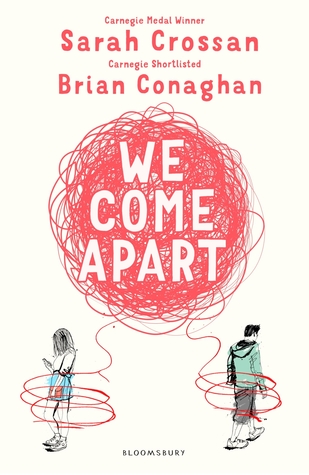
I was somewhat excited about hearing Sarah Crossan and Brian Conaghan talk about their new book We Come Apart at Waterstones, Brighton and arrived about 45 minutes early in my haste to get there on time.  The seats filled quickly and the talk began, brilliantly chaired by Nikki Sheehan (author of Swanboy and Who Framed Klaris Kliff?).  It was absolutely fascinating to hear the story of how two award winning authors with such unique writing styles came together to produce what will no doubt be a bestseller.  We Come Apart, written entirely in verse, tells the story of Nicu, an immigrant from Romania and his relationship with Jess, a a fellow teenager with a troubled home life.  I’m looking forward to reading it, especially after hearing how it came together.

Brian approached Sarah with the idea of writing together and Sarah agreed; and so began an incredible process of writing mainly via What’s App! With no actual ‘plotting’ the story unfolded between them, each author taking on one of the central characters. Brian would write the story from Nicu’s point of view and Sarah would write the story from Jess’ point of view. Rather than plan the story, each author would write responding and reacting to what the other author had produced, so the process was totally organic.  With their own varied approaches to writing it was clear from the conversation that their various strengths and weaknesses blended well.  And unbelievably it took just five and a half weeks to write!  Both authors shared what they had learnt from the process of a joint writing experience. Amongst other things, Brian, to plan a bit more and Sarah, to keep the gremlins of self-doubt at bay! It also came across as a very brave thing to do, which Nikki Sheehan highlighted saying that as a writer ‘giving’ your story to anyone is like giving something or someone very precious away.

When asked if they would do it again, both agreed there wouldn’t be a sequel.  They also said they’d consider writing together again but perhaps in prose. They both have ideas of characters bubbling away so perhaps it’s a case of watch this space!  It sounded like it had been a very rewarding but also quite challenging experience and it was fascinating to hear the creativity behind it.

As a young girl, I will admit I really disliked poetry. Having studied Chaucer (the original text) to death when I was about 14, I think you could forgive me for being put off poetry for some time.  I was somewhat sceptical when I first heard about The Weight of Water and whether it would appeal to young people based on my own youthful experiences. Sarah shared how in the UK it had been a much harder ‘sell’ because of some negative attitudes to poetry.  She pointed out that young people are often more flexible than their elders and they quickly embrace different styles of writing.  Not only that, for many it appeals as it’s often a quicker read and can be easier for children with dyslexia. Sarah described writing in verse as like sewing lots of different pictures together and how you can get to the heart of the story much more quickly when you don’t have to describe every tree and every ‘high road’! Brian and Sarah both talked about how writing in verse enables the reader to use their imagination to ‘fill in’ the blanks, creating those elements of the story that are left out, in the way they choose.  In that sense, it can be incredibly powerful and also very personal.  For me, reading in verse is an amazing way to communicate a story and has gone a long way to restore my love of poetry.

I wasn’t aware that both Sarah and Brian were previously teachers and both of them talked about this and how it informs their writing. Brian spoke about how he would often be talking to the reluctant readers in the classroom so that he could engage them in even just a small amount of reading, so they could feel a sense of achievement and enjoy stories like anyone else. Not being much of a reader himself as a teenager, he can relate to those who don’t read and even now doesn’t read books with a tiny font.  Brian commented that he writes books for people, about real life and real situations and for those who don’t like this, well, they don’t have to read his books.  I can’t help but agree with this sentiment.  Life is a varied and many splendoured thing and writers can choose what they want to reflect on and the reader can choose what they want to read.  Hence why book choice is so personal – and so important.

Sarah shared that as both a teacher and a mother, she felt a sense of responsibility in being very aware of what she chooses to include in her books and that she always likes to end with even just the tiniest glimmer of hope – even if the ending isn’t a ‘happy’ one.  I can’t help but agree with this too – life is hard and full of difficulties, but it’s often our hope in each other and the future that keeps us going and it’s good for young people to believe this.

Brian and Sarah were both hugely entertaining to listen to, and I can only imagine how excited their agents and publishers were when they were told they had written together; this confirmed by the Bloomsbury representatives and Brian’s agent in the audience.

It’s what I love about the world of books and reading; people are so passionate about stories. Listening to those who write them, hearing their enthusiasm and the creativity behind the story is totally inspiring.  I’m so glad I was able to attend and if Crossan and Conaghan are visiting a Waterstones near you, make sure you go if you can!

A review of We Come Apart will follow soon!
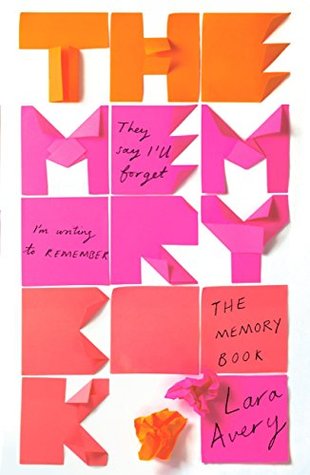
The Memory Book by Lara Avery

the-memory-book-coverSam McCoy is 17.  Sam McCoy was going to be someone – and then she became ill.  Now, she must figure out who she is…..

Told in a diary style narrative, The Memory Book follows Sam McCoy as she deals with a life-changing illness.  Diagnosed with Niemann-Pick, a form of dementia, Sam will inevitably lose her memory.  Determined to give herself the best possible chance of remembering who she is, Sam starts a memory book, like a diary, telling her future self (Future Sam) who she is and what she wants from life.  As she writes, Sam discovers the plans she has made for herself – winning the Nationals, making the Valedictorian speech and going to NYU – are less and less likely to be achieved but with dogged determination she fights her way forward.  Sam’s friends and family provide some support and advice but it’s not always welcome; her illness affects them too.  As it progresses, Sam has less and less freedom, which for a teenager desperate to break free is increasingly frustrating.  Sam starts to realise perhaps she isn’t the person she thought she was and it’s only through the memory book that her true self is revealed.

The Memory Book is an utterly compelling young adult story and I read it in one sitting, staying up till 1am to finish it.  In practical terms, it’s very easy to read with some ‘chapters’ only one line long (so a good choice for teens who don’t want to read a ‘long’ book).  But in emotional terms, it’s heart-wrenching, with the final scenes in particular causing a flood of tears.  I loved Sam; she’s bold and brave and totally inspiring considering what she is facing.  I loved her debate partner Maddie; who takes no prisoners and says it like it is – causing conflict here and there.  I loved Coop; the unassuming, ‘dope-smoker’ from next door, who turns out to be *spoiler alert* the best friend a girl could have.  Sam’s family (Mum and Dad, a brother and two sisters, all younger) are introduced to us through childhood memories as well as ‘current’ moments and Sam’s own predictions of what she thinks her siblings will be like in the future.  Particularly poignant is the scene where Sam lapses into memory loss and ‘forgets’ one of her sisters – with her sister understandably distraught at being ‘forgotten’ even if only temporarily.  Sam’s parents work hard to pay the inevitable medical bills and to stay strong through the horrendous ordeal of watching their child’s health deteriorate.  Through the various relationships Sam has, including with Stuart Shah her schoolgirl crush, the journey of self-discovery is significant. As the reader, you rejoice with her when she manages to achieve some of her goals, mourn those she can’t and feel absolute heartache as her “body is failing”.  Slowly, Sam starts to realise those things she placed so much hope in are not as important as she thought.  This realisation helps her to embrace the life she now has and do her best to enjoy it; a lesson we can all learn along with her.the-memory-book-cover

As a mother myself, I cannot bear the thought of having my sons going through an illness like this. It’s bad enough when they have the flu – you’d do anything to make them feel better.  Magnify this by about a million and that is how I imagine Sam’s mother to feel.  Her words to Sam, her eldest daughter, written in The Memory Book are just beautiful.   The story of Sam McCoy will stay with you long after reading.

Also reviewed for the Reading Zone. Thank you to Quercus for sending me this book.

The Wordsmith by Patricia Forde

the-wordsmith-coverThe Wordsmith, Patricia Forde

Ark is a place of tally sticks, rationed food and shared shoes, where art and music are banned, language is severely restricted and outcasts are thrown to the wolves. Letta’s job is to collect words and dole them out to people who need them.  When she discovers that John Noa is planning to rob the people of language altogether and make them Wordless, she has to stop him. But she’s only a young girl and he’s the leader of the known world.

Letta is an apprentice, learning the trade of the Wordsmith; perhaps the most important role in all of Ark.  Letta makes the word cards that people are allowed to use in their daily lives – anything not a ‘List’ word is forbidden.  For words are considered to be the cause of the Melting; they are the root of all evil and therefore restrictions ensure there will be no more trouble. The rule of law is created by John Noa and Ark is policed for him by gavvers; ruthless men who will do anything they can to ensure the law is followed.  Anyone found to be challenging the law, a Desecrator, is banished to the wild. Benjamin, the Master Wordsmith, has been Letta’s family since her parents were lost.  He often reassures her that all will be well, even when unrest spreads across Ark and outside the walls in Tin Town. When Benjamin meets his death on a word-finding trip and a Desecrator named Marlo shows up in her shop with bullet wounds, Letta starts to question everything.  The reality of Ark suddenly becomes more like a prison; Letta realises John Noa is not all he seems and that everyone is in danger.  Now the Master Wordsmith, Letta must overcome her fears and challenge all that she thought she knew to uncover the truth.

The Wordsmith is a beautifully written tale illustrating the importance of language and creativity and the power they have to change lives. Suitable for ages 11+, it has a detailed narrative and clever plot, you are instantly drawn into the post-apocalyptic world of Ark.  It takes a moment to get used to some of the conversation which takes place using only ‘List’ words, but this perfectly creates the atmosphere of what it must be like to live in a world without proper communication. The heroine Letta, for whom you feel great empathy, is full of imagination considering the time she lives in, and very brave.  Saving Marlo leads her to find out what life should really be like and how creativity is part of being human – as well as discovering the Desecrators are not the monsters she thought.  The monster, is in fact, John Noa, who has clearly become obsessed with controlling all those around him through taking away their words.  It is a frightening thought and there are some unpleasant moments where you realise just how far he will go to ‘save’ society.

As Letta’s journey to discover the truth unfolds, we find out what happened in the Melting (global warming) and how this has destroyed the world as we know it –a potential future that is a little too ‘real’ for comfort.  Letta meets many brilliantly described characters; each of whom has a different experience to share; each of whom lead her on to the inevitable confrontation with John Noa. As well as being a great adventure, with plot twists to keep you on the edge of your seat, The Wordsmith captures many of the concerns we have in society today. Raising questions of science, faith, religion, old age, poverty and the power of freedom of expression , I thoroughly enjoyed this story and really hope there will be a follow-up!
Check out my interview with Patricia Forde; not to be missed!

Find out more about Patricia Forde at www.patriciaforde.com and follow her on Twitter @PatriciaForde1

Thank you to Little Island for sending me this book to read and review.


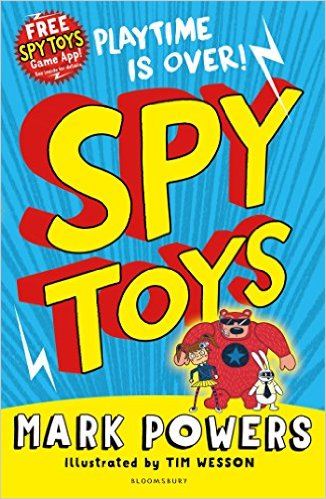
Spy Toys by Mark Powers

spy-toys Spy Toys by Mark Powers, illustrated by Tim Wesson.   
The world’s leading toy manufacturer makes playthings for the rich and famous, and every toy they create contains a tiny computerised brain and a unique personality. These toys are seriously awesome! But every so often there’s a faulty toy…

Dan is a Snugaliffic Cuddlestar bear – he should be perfect for hugging. But because of a faulty chip, Dan is so strong he could crush a car. Thrown on to the rejects pile, he meets Arabella, a Loadsasmiles Sunshine Doll, who has a very short temper and is absolutely NOT good with children. Soon Dan, Arabella and Flax (a custom-made police robot rabbit gone AWOL) are recruited by the mysterious Auntie Roz, and together they make up The Spy Toys. Their first mission: to protect the prime minister’s son from being kidnapped…

Dan the Snugaliffic Cuddlestar Bear really wants to be able to do what he was made for – give people a hug and play! But he’s so super-strong he just can’t help but squash anyone he hugs. Thankfully, he’s given a second chance by Auntie Roz, along with Arabella – a doll with attitude to say the least – and Flax – the oddly clever bunny. Hoping to prove themselves, they become Spy Toys! After some rigorous training – with the help of the McBiff Triplets – the Toys first mission of protecting the Prime Minister’s son is more of a challenge than it first seems. Soon they are thrown headlong into a thrilling spy mission to defeat a maniacal villain. Dan and his new comrades not only have to learn to get along and fight the baddies, but also overcome their own ‘faults’ to succeed….

A fantastic story full of thrills and spills and perfect for younger readers (age 6+). Who wouldn’t love a story about toys coming to life?! Spy Toys is reminiscent of childhood favourites- think Super Ted and Danger Mouse. Add to the mix elements of Alex Rider (Stormbreaker) and young James Bond, and you get Spy Toys. Children will love the action sequences, humour and general mayhem caused by our heroes, and by characters such as the McBiff Triplets and arch enemy Rusty Flumptrunk.

You can’t help but like Dan, who so wants to get it right; it might take a little longer to warm to Arabella – who couldn’t be further from a ‘Sunshine Doll’! Bold and bright illustrations by Tim Wesson, bring the humour to life and aside from all the fun and excitement, the message that just because there’s something ‘wrong’ with you doesn’t mean you can’t achieve anything is evident throughout. All in all, Spy Toys is a great fun read which I’m sure will have children clamouring for the next one, in this sure- to- be- a- hit series. And there’s a game tie-in adding to the appeal for the more reluctant reader!

Find out more at www.spytoysbooks.com., www.timwesson.co.uk and follow Mark Powers on Twitter @mpowerswriter.

With thanks to Bloomsbury for sending me this book to review.

A Sky Full of Kindness by Rob Ryan

ryan_a_sky_full_of_kindness

A Sky Full of Kindness by Rob Ryan

Join two birds on an epic adventure as they become parents for the first time…

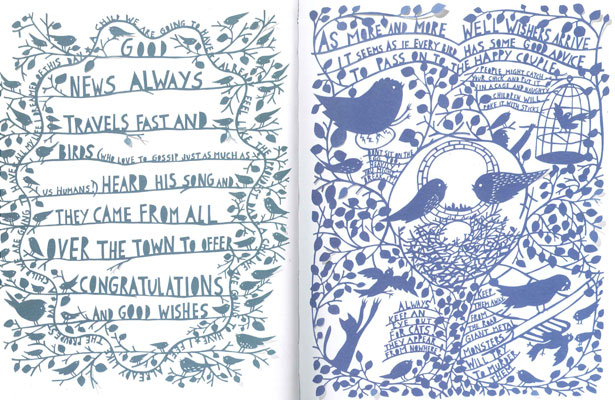
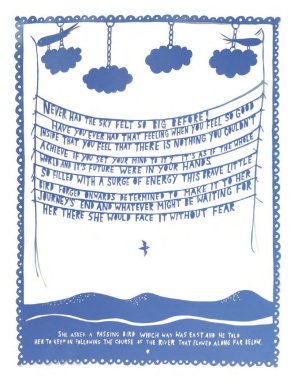
The story begins with two birds who are ecstatic to discover they are going to be parents. Their fellow feathered friends are overjoyed for them, but are soon sharing their wisdom, causing the mother bird to become frightened about all the potential perils of parenting. Are they ready to have a child? Such is her fear, the wisest and oldest bird of all sends her on a journey of discovery to see if she can find some peace about what lies ahead. The journey takes her across the land and sea and she meets many other birds of all different kinds, each reassuring her through kindness that whilst the world might be big and full of danger, there are many people in it who can help when you most need it.

sky-2

This is a stunning book by the incredible artist and illustrator, Rob Ryan. The artwork alone is a sight to behold; each word and image beautifully paper cut down to the finest detail. The story itself is lyrical and flows beautifully; a tale depicting the journey towards parenthood with all its highs and lows and everything in between. Poetry and prose combine, with each word literally illustrating the magic of the childlike but utterly insightful narrative. The mother bird is determined to find out how she can allay her fears, travelling over the widest oceans and unknown lands looking for answers.

sky-3

The other birds she meets are strange and exotic, each with their own wisdom to share, each showing her kindness. The mother bird repays the kindnesses she is shown along the way and she finally realises that through being kind, brave and finding hope, she can face her fears.

sky-1

A Sky Full of Kindness is a heart warming tale about unconditional love, the hopes and fears we have for our children and ultimately shows how kindness can change the world we live in. A must-have book for everyone’s bookshelf!

Find out more about the author and illustrator at www.robryanstudio.com and on Twitter at@RobRyan_Art. A Sky Full of Kindness is published by Chronicle Books.

Review can also be found at Discover & Be.