Tag Archives: Education

Editor Interview: Hannah Rolls on Bloomsbury High Low Fiction

flowers 2

I’m delighted to welcome Hannah Rolls, Editor at Bloomsbury who works on the brilliant Bloomsbury High Low books.  Published this spring, the series aims to encourage and support reading practice by providing gripping, age-appropriate stories for struggling and reluctant readers, those with dyslexia, or those with English as an additional language. The High Low series is produced in association with reading experts at CatchUp, a charity which aims to address underachievement caused by literacy and numeracy difficulties.

Hopewell High, The Street, Mission Alert and Skate Monkey are four new series in the High Low range offering exciting and dynamic stories. Each title is printed on tinted paper with a dyslexia friendly font and a recommended reading and interest age. Thanks for joining us Hannah!

Tell us a bit about your role at Bloomsbury. I look after the educational fiction list. That means I’m always on the lookout for stories which might be useful in schools – either to help children who are learning to read or to tie into topics they will be covering. My job includes a bit of everything: negotiating contracts, editing manuscripts, writing briefs for illustrators, talking to teachers about what they need, wandering around bookshops to see what is going on in the world of children’s books…

high low bloomsbury

The High Low series is great! Can you tell us a bit about the series and what makes these books more accessible than standard paperbacks? We know there are loads of children out there who struggle with reading – because English isn’t their first language, because they have dyslexia or another special educational need, or just because they didn’t ‘get’ it when all their peers did. But poor reading skills have a massive impact on children’s chances in life – struggling to read is closely linked with low pay and unemployment.

So, to try and help tackle this problem, the High Low series was developed so that the interest age of the books is higher than the reading age (you can see both printed on the back near the barcode) so that children who are struggling with reading don’t get stuck with books they find babyish or boring. The typeface we use is one that is recommended by the British Dyslexia association so it is really clear, and we also use cream paper to improve things for anyone with Irlen syndrome or other visual problems associated with dyslexia. We look carefully at the plots and the language to make sure they will be readable and engaging to our target audience and we try to keep the books quite short so that everyone can get the satisfaction of finishing a story!

How do you go about commissioning the High Low books? First, I looked at what other children that age would be likely to be reading. I was really keen that we should cover a wide range of different genres and that if their friends were all reading the latest superhero or spy book, that we would be able to give the struggling readers something that looked cool in the same way.  We don’t have every genre covered yet but I hope we will soon.

Then, I talked to some authors (some I had worked with before and some I hadn’t) about what they might want to write about and tried to match that up with things I knew were popular. I also did some research into what can help struggling readers, and had a lot of meetings with the design and production teams about typefaces and paper!

The series was produced in association with CatchUp; what was their role? CatchUp are key in making sure everything is as tailored as it can be for struggling readers. They have experienced teachers who act as language editors for me – they spend a lot of their time working with struggling readers so they can advise on whether a sentence structure is too hard, if a particular word or plot twist will be sensitive in schools, and even a word has gone out of fashion in the playground! They also took a close look at design of the series and the font to help us make sure we got that right.

And finally, what do you think is the key to successful books for children/young people with specific learning needs or who are reluctant readers? I think the key is to remember that they aren’t all the same – some of them will think it is the coolest thing ever that a giant octopus fights an underwater dragon in Skate Monkey: Fear Mountain whereas some of them will be engaging with the emotional struggles of the girls at Hopewell High… Some of them will be struggling because they are newcomers to the English language, some will have specific difficulty and some will just have found books a bit boring! I always try to make our books as … as possible: as funny as possible, as exciting as possible, as dramatic as possible, and so on. When you get right down to it, every child is different but they all deserve the chance to become readers.

Thank you Hannah for sharing some insight into your work and about the High Low Fiction series.

For more information visit www.bloomsbury.com

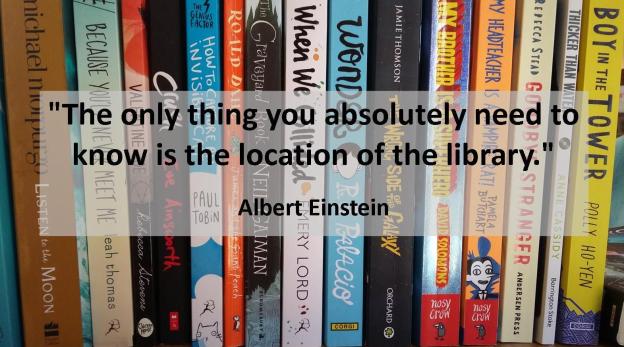
Spring time quote

Libray-versary: a decade in school libraries!

This time ten years ago I took my first steps as a School Librarian. I can’t actually believe it’s been ten years.  It was never my plan to work in a school library, dare I say it?! But I’ve always been a reader and always loved books. I loved visiting the public library as a young girl, taking out as many books as I was allowed, devouring them one after another.  This was where I discovered some of my favourite authors –  causing a few raised eyebrows as I took out virtually an entire shelf of books by the same author!

I’d had various ideas about what I wanted to do when I grew-up, but as is often the case life happens and plans change or adapt.  When I did my degree, I recall thinking the Classification unit was really quite boring and I would avoid the Dewey System if I could…! I worked in events management initially after University and as a ‘born organiser’ (as my parents would say), this suited me very well and I loved it.  The arrival of children meant it was difficult to balance this career (late nights, long days and lots of travelling) with parenting and this is when I applied to work in a local school in the library. I will admit like many who are attracted to working in schools, the hours and holiday times were well-suited to family life. But little did I know this would lead me to discover a brand new career and rekindle my passion for books.  Not that I had ever stopped reading; I hadn’t, but I had never thought about sharing and encouraging others to discover a love for reading, beyond my book group.

It was a huge culture shock going from industry to working in a school. After six weeks I had a complete panic and went to see the Personnel Manager to discuss handing my notice in.  She was brilliant – kind and reassuring and encouraged me to stick with it till the end of that term, saying that many people who come from industry find it a big adjustment.  She also sent me on a training course  all about how to run a school library.  This was a huge turning point for me.  I suddenly realised the value of the job I was doing and will never forget what the man running the course said:

“You can either be the person who sits behind the desk stamping books or you can effect real and positive change in the lives of the children who walk through the school library door.”

It was definitely a light bulb moment for me. Up until that point, I had felt that I had no real purpose other than to look after the very dusty and underused library space, stop students from misbehaving when they came in for the odd lesson and issue the occasional book. I went back to school with a new focus: I was going to revamp the library and make it a hub of activity! A place where students couldn’t wait to be; where they felt supported; where they were inspired and most importantly, a space that celebrated and enabled the discovery of the joy of reading.

Quite a challenge in a library that had had little love or attention for many years!  But despite this, I did achieve a huge amount, working with some great people, of which to this day I feel very proud.  I was able to make good use of the skills I had learnt in running events, marketing and PR. At its simplest level, I saw the library and books as the ‘product’ and the students and staff as my target audience.  It was just a case of working out the right sales pitch amongst other things!

This first experience stood me in good stead throughout my career and I’ve had the rewarding task of revamping nearly all the libraries I’ve worked in.  I’ve learnt a huge amount over the last decade. Not just in terms of running a library; but also working with children, school staff and parents; in teaching and learning; understanding special needs; general education issues; managing a team and a myriad of other things I’d never even thought about.

Without the wider support of those working alongside you, a school library (and the librarian) can quickly become obsolete.  I’ve collaborated with some amazing teachers, teaching assistants and fellow librarians, who have been fundamental to ensuring the success of the libraries I have worked in. I’ve also continually developed my understanding of the importance of reading to a child’s development across all areas of their lives.  I realise how incredibly blessed I was to discover a love for reading at a young age (thank you Dad) and have it come completely naturally to me.  And now even more, I realise that it was a lot easier to grow-up when I was young; these days children have so much to deal with and as school librarian I feel a huge sense of responsibility in supporting young people in school. It’s this that keeps you going when you’re having one of ‘those’ days.

Since that first day, I have worked with nearly 7,500 children ranging from two to eighteen years.  It is a unique position to be in, interacting with the entire school community. In a single day, librarians can be teaching and supporting upwards of five different curriculum subjects for a range of ages, taking book groups, running reading campaigns, recommending books to individuals, writing school policy, as well as the general administration of the library. Add to that the role of tutor in my current position to a group of Year 8 boys and it’s busy!  Perseverance is key as are good working relationships. It is absolutely a full time job and should never be underestimated; but it’s also totally rewarding.

This career has led me to some wonderful things, not least founding The Book Activist. I’ve had the absolute pleasure of sharing my love for reading and been able to read hundreds of wonderful books ‘for work’! I’ve faced challenges in ways I couldn’t have imagined and I’ve had moments of fulfilment that I will never forget. I’ve been fortunate to work with some lovely people and made some friends for life. So on my library-versary, it’s a good time to thank all of those who have supported, inspired and encouraged me. And to thank all the many children who have made my job so rewarding.  And of course, all those amazing authors, illustrators, publishers, editors and brilliant book-ish people who create the stories we love.  I don’t know where the next ten years will take me, but I expect if books and reading are involved, it’s going to be brilliant!

signpost


A Super Saturday – at Oxford Literary Festival 2017!

WinnieTheWitchIntroducing Korky Paul at the FT Weekend Oxford Literary Festival, Saturday 25th March.

The day dawned bright and fair. ‘Suited and booted’ wearing my favourite Dorothy-inspired book-ish shoes, I set off to the beautiful city of Oxford for the first day of the FT Weekend Oxford Literary Festival.  I had been asked to introduce none other than Korky Paul, illustrator of the fabulous Winnie the Witch books.  On arriving, it was with great delight I spent an hour or so chatting with Korky and helping a real life Winnie the Witch get ready to entertain the audience!


About 80 or so children and parents arrived, all hugely thrilled to meet Korky – and of course Winnie, who willingly posed for photos with them.  After introducing Korky, I sat back and watched in wonder as he brought to life Winnie, Wilbur and all their wonderful adventures.

With prizes and stories along the way, everyone went away utterly delighted. Korky shared brilliant illustrations tips and was so encouraging of all the children and even read aloud one of the stories.

It really was a special morning. There are few things more inspiring than watching an illustrator at work, perfectly capturing the expression, movement and magic of a character everybody knows and loves!

“Seeing the World Through Children’s Books”  with Elizabeth Laird, Gill Lewis and Anna Bassi, and Nikki Gamble

IMG_3909

This was a great opportunity to hear from two renowned authors and the editor of the fantastic news magazine for children, The Week. Chaired by Nikki Gamble from Just Imagine, the discussion focused on why it is so important to write about the real world for children. Each member of the panel gave a brief talk about their work, starting with Anna Bassi, editor of The Week, a magazine for children which aims to make the news accessible for younger readers.

Anna talked about balancing new stories “with fun stuff so that children could see that the world is not all bad; it’s huge and interesting”.  Having subscribed to The Week both at home and in the school library, I’ve always found it to be an excellent source of news for children and also full of interesting facts, competitions and great stories from around the world.  It is also, most importantly, as Anna described “a safe place to read about serious stories”. I think the whole audience could appreciate the challenge of making news accessible for children in the current climate.

51xdfc5-aUL._SX258_BO1,204,203,200_

Gill Lewis, author of award winning wonderful books such as Sky Hawk and Scarlet Ibis, then shared her inspiration for her new book A Story Like the Wind (out next month), an incredible tale about refugees which Gill described as a “story about the power of stories”. She also spoke about Gorilla Dawn which focuses on the destruction of gorillas and their habitats through the mining of minerals for mobile phone technology.

Gill shared some wonderful insights into her writing, such as taking big events down to one narrative to make the story accessible for young readers.  She talked about finding the character within the story to enable you to create a narrative and enable children to relate to the story.  Gill described her writing as not writing for children, but writing as a child, “exploring what it’s like to feel utterly powerless in an adult world.”

Elizabeth Laird, whose work was characterised as “intrepid” by the panel chair Nikki Gamble and has been translated into 25 different languages, was the final author to share her thoughts.  Her books include the amazing, award winning The Garbage King and The Fastest Boy in the World. Elizabeth talked about her latest novel Welcome to Nowhere, a story about Syrian refugees.  Elizabeth shared an experience of seeing hundreds of refugees arriving at a train station in Munich, making her think of other historical events where multitudes of people have been forced out of their homes.

9781509840472welcome to nowhere_jpg_262_400

This motivated her trip to the Middle East and led her to writing Welcome to Nowhere. Elizabeth made an impassioned plea to the audience to help those “people just like us with perfectly good lives who are now refugees”. Elizabeth’s presentation included images of the refugee camp she visited, home to some 80,000 people.  She also spoke about the children living in absolute poverty on whom some of her other novels are based, and moved many in audience to tears with some of her stories – including me.  Elizabeth encouraged all members of the audience to get involved in raising funds for The Mandala Trust, a charity supporting two schools opened especially for refugee children.  Find out more on her website www.elizabethlaird.co.uk.

The overall thread was the importance of ensuring a message of hope whilst still being true to the story or narrative.  Younger readers should not be patronised but neither should they be made to feel complete despair.  Nikki Gamble asked if there was a line the panel members wouldn’t go beyond with their readers. In response, Elizabeth spoke of having a duty to encourage readers, always showing hope. Gill has had readers who have thanked her for writing stories even about the most difficult of issues, because it helped them get through their own experiences.  And Anna shared that even with the darkest of news stories; there are always opportunities to remember what good people there are in the world, focusing on everyday heroes.

It was a fascinating hour, looking at the power of both fiction and non-fiction to enable children to see the world more clearly.  I think the conversation also showed the ability writers have to help children feel empathy and make informed decisions about the world around them.  This demonstrates why reading is so important, especially in a world which is so visible to children, but also so full of things that are difficult to understand.

Find out more about the Oxford Literary Festival at www.oxfordliteraryfestival.org which runs until 2nd April.

And look out for an interview with Gill Lewis coming up as part of our Spring Feature!


Non-fiction: why is it so important for children’s reading?

download

You may have noticed that November has been National Non Fiction Month. With so many days and occasions to celebrate reading, the focus is often on fiction.  This of course, is wonderful and absolutely as it should be. But it’s also wonderful and as it should be that we celebrate the plethora of amazing non-fiction books out there for children.  And that’s just what the Federation of Children’s Book Groups does through National Non Fiction month.

So why is non- fiction so important for children’s reading?  Well, one might say, it teaches them about the world and helps their education perhaps supporting whatever current topic they’re working on. And of course this is true; knowledge is empowering at any age. But it’s more than that. Because for some children, reading stories just isn’t something they want to do or perhaps it’s something that they can’t do.  So non-fiction opens a door to reading ensuring they too can experience the wonder of words.

Non-fiction books help children unlock the world around them, but also enable them to participate in reading, tapping into their varied interests and engaging them in a way that stories sometimes can’t.  If a child has a learning need, they can struggle with understanding the often inferred narratives in a story – with non-fiction they don’t have to worry about this, they can just read the facts off the page!  Would you believe that many children I have worked with say they don’t want to read because they don’t like stories? Of course I explain to them that this is simply not true, they haven’t found the right book yet.  But if they are adamant and don’t want to read a ‘story-book’, I will establish what their interests are and recommend a wonderful non-fiction book as a starting point that fits the bill; whatever the topic there’s bound to be something they will enjoy.  As it’s not a ‘story’ and it fits in with their interests, they start to read.  And whilst they read they are still benefiting from language, vocabulary and expression through the information presented in front of them.  This is amazing sight to see, when you’ve had a student roll their eyes on being asked to read – and a little while later they’re busy enjoying a book!

There are some simply gorgeous and amazing non-fiction books produced today for all ages with beautiful illustrations bringing the information to life. The FCBG have put together an amazing list of 100 children’s non-fiction books; plenty of ideas to choose from!

And there’s always what are viewed as the more ‘commercial’ non-fiction books; the Guinness Book of Records, Lego, Minecraft……a bone of contention for some; ‘It’s not reading’.  Well actually, yes it is. It’s a start. And for those young people who are so switched off from reading they’d rather stare at the wall, it’s the perfect combination of words, pictures and fantastic facts.  Without even realising it they become engrossed in a book, through something that interests them.  It’s a step on the road to reading – it’s fun and above all we want children and young people to associate their reading experiences with fun.  Once they find the joy of books, they are far more likely to develop a reading habit. Sadly not all have had a positive start to their reading journeys, not all have homes with books in and many have a complete lack of input as they get older.  So if we can find something that hooks them, non-fiction or fiction, little by little they will discover reading for pleasure.

How to get teens to #LoveToRead.

Waking up at 5am with a horrible cold, I got up and sat with my lemsip, flicking through the somewhat weird and wonderful world of early morning TV.  I remembered I’d yet to watch ‘The School that Got Teens Reading’.  This is just one of the programmes scheduled for the BBC’s #LoveToRead campaign, so I settled down, between sneezes, to see what it was like.

I’d never heard of the exuberant Javone Prince before. He admitted to being somewhat nervous having no experience of schools other than his own schooling – I don’t blame him! I remember my first ever library lesson about ten years ago – I was absolutely terrified. But what he lacked in experience he made up for with enthusiasm; it was great to hear how much he loves reading and wanted to share that passion with the students.

Continue reading