
Today is publication day for a brilliant debut middle-grade novel from author Damaris Young, The Switching Hour – congratulations! Damaris studied on the Writing for Young People MA at Bath University, where she wrote this novel taking inspiration from her childhood in Southern and Central Africa. Damaris now lives in the UK and I’m very excited to be hosting a guest post by her on the blog today!
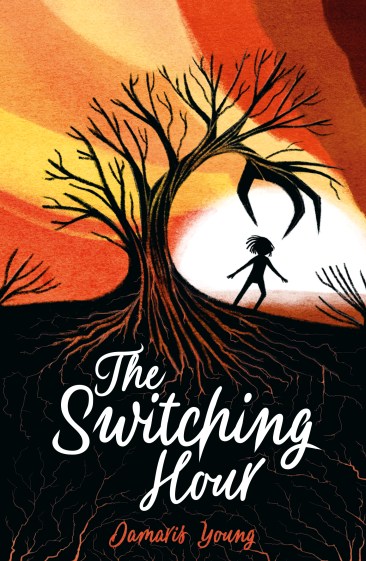
Cover art: Kelsy Buzzell
The Switching Hour is set in a land suffering from a terrible drought, which has unleashed a dark and dangerous creature, Badoko, who snatches children away to eat their dreams. One night, Amaya’s little brother Kalen is taken and Amaya embarks on a nerve-wracking, spine-tingling chase to rescue him. She only has three days before The Sorrow Sickness sets in and all memory of her brother is lost. Accompanied by her faithful companion, her goat Tau, Amaya meets Mally, and finds the true value of friendship as together they search for Kalen in the heart of the Blackened Forest. Full of bravery and heart, The Switching Hour, weaves a wonderful tale, drawing you in, bewitching the senses and showing the true power of family bonds, in the face of absolute peril. A fantastic read and one that highlights the havoc that climate change can cause – watch out for the Badoko!
I’m delighted to welcome author Damaris Young to the blog today to share her thoughts on writing about the weather in The Swtiching Hour and how it represents a force to be reckoned with.
Writing About Weather In The Switching Hour by Damaris Young
“Writing about weather can very easily get overlooked when you’re speeding ahead to get the exciting bits of the plot, but it is such a vital part of writing a story. Weather is a key player and often drives the action by affecting the characters behaviour or mood, or adds tension and conflict, like a storm on the horizon.
I find that it’s all too easy to resort to clichés when it comes to writing about weather, so I allocate time to really think about new and fresh ways to describe it. I find it helpful to go outside into the garden or the park and close my eyes; can I smell the rain? Can I hear the wind? Can I feel the cold or the heat?
In The Switching Hour, it was very important to get the weather right, as it is set during a terrible drought. In my story the drought unleashes a creature that is my interpretation of climate change, a monster that eats the dreams of the young in much the same way that climate change affects the generations to come.
To immerse the reader in the story, I had to focus on some of the main elements of weather: wind, temperature, pressure, humidity, clouds, and precipitation. In every scene, I had to be thinking how the temperature would affect the characters, how the lack of clouds would mean the sun was brighter and harsher, the lack of wind would mean there was no reprieve from the heat. My protagonist, Amaya, seeks out shade on her journey but the ground beneath her feet becomes increasingly too hot to walk on. The lack of rain means that the leaves fall off the trees, the ground cracks and the food resources become scarce.
I lived in the Kalahari Desert in Botswana for many years growing up, where there is low rainfall for large parts of the year and where the natural plants and animals are adapted to the climate. I drew on that experience to write about the heat and the lack of rain, but what I wanted for The Switching Hour was to write a story about an extreme weather event and its devastating effects, much like climate change has an impact on global weather patterns.
For me, the most important thing to remember when writing about weather was not to underestimate its value to the story. I wanted the drought to be a character in itself and so I treated it like a character, giving it motives and thoughts and desires through Badeko, the Dream Eater. This in turn, changed the weather from an afterthought to becoming something real and powerful, a force to be reckoned with.”
Find out more www.damarisyoungauthor.com
With thanks to Scholastic for sending me this book to review and inviting me to host a guest post.


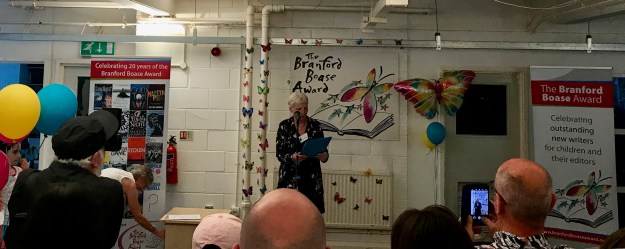
 I was delighted to attend the 20th




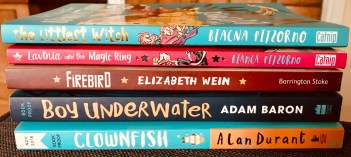
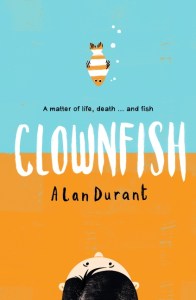 Clownfish by Alan Durant is a quirky tale of a boy, Dak, whose father dies and unbelievably comes back to life – in the body of a clownfish. Dak and his dad often visited the local aquarium together and when Dak goes there to escape his grief-stricken home, he is amazed to hear the voice of his dad coming from one of the fish tanks. As Dak navigates the days following the fallout of his father’s death, especially his mother’s grief, he takes comfort in his secret knowing he can always talk to his Dad at the aquarium. However the lines between what is real and Dak’s desire to believe his father is still alive become blurred and Dak ultimately will have to face the truth. Clownfish is a funny and moving portrayal of grief and acceptance. Well-paced, it sensitively deals with the very painful theme of losing a parent, alongside a funny narrative of making new friends and a campaign to save the aquarium from closure. Published by
  Boy Underwater by Adam Baron and illustrated by Benji Davies is a debut novel and also deals with themes of grief and bereavement. Told from the viewpoint of Cymbeline Igloo (what a fabulous name!) it begins with an innocent desire to learn to swim. So begins a series of events that spark a breakdown in Cymbeline’s mother’s mental health, a desire to find out the truth about his father who died and the discovery of a painful secret. Along the way, Cymbeline loses friends, finds new ones and has to face the fact that his family are not what he thought they were. Boy Underwater is a moving story, told with real humour and insightful observations about family and friendship. The wide cast of characters generate real empathy and reflect the realities of choice and consequence, demonstrating how grief can cause even the best intentions to go awry. It’s also just a great story about growing up. A really impressive middle-grade debut published by
  Firebird by Elizabeth Wein is a young adult novella centred on the Soviet women pilots of the Second World War. An engaging read, with a fearless heroine Nastia who is the daughter of revolutionaries, Firebird brings new insight into what wartime Russia was like. Nastia and her comrades must not only battle the prejudice against women wanting to fight in wartime but also the attacks of the invading German army. She perseveres and with the help of her fierce female instructor, The Chief, she soon finds herself on the frontline. The story cleverly weaves in Russia’s most famous family, the Romanovs and shows just how far people will go to protect their Motherland. Firebird is published by
 The Littlest Witch is a charming tale of a mad-cap family and their discovery that the youngest daughter, Sybilla, is in fact a witch. Which wouldn’t be a problem given the chaos of their family life, were it not for the witch-hunting Alfonso who needs to marry a witch in order to claim his huge inheritance. A variety of fantastic characters feature including Sybilla’s six sisters, the nanny Diomira and her heroic nephew Zac, a cat called Mephisto and Shut-Up the parrot to name a few! Alfonso’s ambitions get the better of him and he finally kidnaps baby Sybilla, trapping her in basement. But he forgets she is a witch and he also doesn’t count on her unconventional family! I won’t spoil the plot, but suffice it to say, Alfonso gets his just desserts and there is a happy ending in store for all! Lively illustrations by Mark Beech bring all the adventure to life. The Littlest Witch is everything a good story should be; full of character, funny and entertaining with a little bit of chaos thrown in!





 thebookactivist