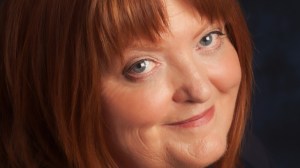
 I’m so excited to present my first author interview of 2017 with Patricia Forde! Patricia has written picture books, plays, TV dramas for children and teenagers as well as writing for various soap operas – in both English and Irish. Her first novel, The Wordsmith, was published by Little Island in May 2015.
Thank you Patricia for joining the blog today.
How did you come up with the idea for the character of the Wordsmith? For me, writing often starts with a single image. With The Wordsmith I had an image of a young girl selling words in a shop. Interestingly, I spent a lot of my young years behind the counter of my family’s shop so it was a familiar setting for me. My husband had just come back from the USA and had brought me a visual thesaurus for my computer. I remember thinking that it was as if he had bought words for me. I then spent months trying to figure out who this girl was and what kind of place would have people who needed to buy words. The story and the character began there.
The Irish language also played a part. I am bi-lingual and write in both languages. I feel that in my adult life I have been attending a wake for the language. Gradually, native Irish speakers are using more and more English words in normal speech. Apparently, a minority language like Irish, dies, by being cannibalised by the stronger language, in our case English. Working in that environment and seeing the ‘list’ of words we use diminish definitely influenced me when creating Letta and her world.
 The Wordsmith ‘collects’ and distributes words throughout the book. I thought the List was a great – if scary – idea. I also thought it was clever to show how restricting the words that can be used affects communication. How did you decide which words to ‘keep’ when writing List dialogue and did you worry about this affecting the narrative?The list of words came from an American linguist. I found him on the internet and asked him what was the minimum number of words needed to hold a basic conversation (How many words do you need to survive?) He very kindly responded and said 500 and then sent me a list of the 500 words you would use. I doctored the list to my own ends. I added words like ‘desecrator’ for example.
I did worry initially about restricting my vocabulary but then I invented rules to help me get over that. In the novel Letta speaks the ‘old tongue’ to her master, to Marlo, to John Noa, and of course, in her own head. This made easier for me to express myself fully and not feel that I too had to conform to the List.
Freedom of expression through the arts is a key theme in the book. What do you think is important about the arts in our daily lives (not just as a means to make a living)? We are the only species on Earth that has more than one life. We have the possibility of imagination. We are able to imagine what will happen- after lunch or in a thousand years time. We not only experience the reality of every day but we have the facility to step out of the normal and into the ‘other’. Music, poetry, art and stories all act as portals to help us make that transition. I think it is central to our mental health and wellbeing to be able to make that leap. Personally, I’ve always been a reader. No matter what calamity was playing out in real life, I had the ability to escape into a book. I passionately believe that every child should have the right to have access to that door. I was lucky to have been born into a home where books were valued and into a community where education was freely available. I was lucky to have access to a public library. I think, as a society, we need to value the arts more and realise what a great privilege it is to be able to freely enjoy artistic expression.
You touch on people’s desire or need to believe in something in the novel. The statue of the Goddess indicates some of the people’s past beliefs. Why did you include this theme in the story? I grew up in a very Catholic tradition and even though I have major criticisms of the church as an organisation, I loved all a the symbolism and ritual attached to it. I also loved the comfort and reassurance that faith brought. In Ireland now, the idea of faith and belief is slowly falling away. In the novel, I show a people who have left it behind them but still yearn for something supernatural to believe in.
The’ Melting’ in the novel has been caused by man’s own ignorance which has resulted in the catastrophic destruction of society. What inspired you to write a novel with this as a central idea and did you research the issues surrounding this to inform your writing? The destruction of the environment has been such a hot topic in recent years. I live on the outskirts of Connemara on one side and the Burren on the other. Both of these places are spectacularly beautiful with granite mountains in Connemara looking down on the wild Atlantic ocean and miles of bone-white limestone in the Burren peppered with rare wild flowers. I did a lot of research into global warming and its consequences. It is horrifying to think that we are destroying fragile places all over the world. And of course we are endangering insects, birds and animals as well. One of the things I mention in the book is that bees had become almost extinct before the Melting. I love bees. My grandfather kept a couple of hives and Ireland has a lot of folklore connected to them. For instance, the old people would say that you should always inform the bees if someone in the household dies. Otherwise, they will swarm and leave the hive. This is because bees are very sensitive and easily offended.
*SPOILER ALERT* – Letta and Marlo seem destined for each other (and yippee so they were!!) Did you feel it important to have an element of romance in the story? No I didn’t! I had no hand, act or part in it. My plan – such as it was- did not include a love story. Sometimes, characters take on a life of their own and stop going along with the writer. It started with a few glances. She noticed he ‘smelt like sage’ and before I knew it, they were in love! Eventually I had to give in to them and I was quite happy when they got together at the end.
I love the narrative and the deliberate descriptions you include – such as when Letta is making the ink for her words using the beetroot. This being your first novel (having previously written television dramas, plays, early readers and picture books) how did the writing experience differ? As far as books go, everything I had written before this was a sprint. The novel was a marathon. There were times when I found it hard to be patient, hard to slow down and describe things, to let the engine idle for a minute. I had to constantly remind myself to stop plotting and to look around me and tell the readers what I saw. On the positive side, I loved having time to say all the things I wanted to say and I loved having time to spend with the characters, especially Letta. I was shocked at how much I missed her company when the story finished.
And finally, to any aspiring writers out there what would your three best pieces of advice be?!
1. Read everything you can and especially read books that you love.
2. Write as much as you can. Write every day if you can but don’t get hung up on that. Everyone is different. There is no right way and there is certainly no wrong way to write. You are the only one who sees the world from behind your eyes. Tell us what you see and we will be interested. Don’t worry if you don’t see vampires or wizards. I don’t think anyone will mind.
3. And finally, never, ever give up.
Wonderful advice,thank you Patricia! And some really amazing answers here too.

 The Wordsmith, Patricia Forde

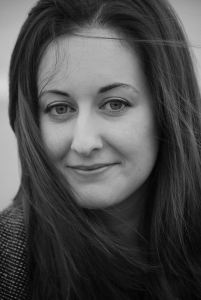 Kat Ellis grew up in North Wales and studied English with Creative Writing at Manchester Metropolitan University. She is an active blogger and amateur photographer. Kat has had short stories published and wrote Blackfin Sky last year after trying her hand at sci-fi. Her first published novel, Blackfin Sky will also be released in the US next autumn.


 Reader’s question from the children Warden Park Academy: we sometimes have to correct our creative writing. How do you feel when you have to make corrections to your work? Before I share a story with anyone else, I read it over and over, looking for mistakes and polishing it to make it as good as possible. But – and I don’t think I’m alone here – I inevitably reach a point where I can’t look at my own work objectively, and I might miss a mistake that’s obvious to someone reading it for the first time. That’s why I’m always grateful to work with editors; they offer me expert guidance to make my stories flow better, and make my writing more polished. Writing is a skill you never stop learning and honing, so it’s great when you have someone helping you to improve.


 thebookactivist